Every batch of kombucha begins the same way. You pour sweet tea into a jar, add some mature kombucha, introduce a living culture, cover the jar, and wait.
At first, it does not look like much is happening. The jar simply sits there on the counter. No fireworks. No bubbling volcano. Just a quiet container of sweet tea, perhaps with a strange rubbery disk floating near the top.
But inside that jar, an entire microscopic community has gone to work.
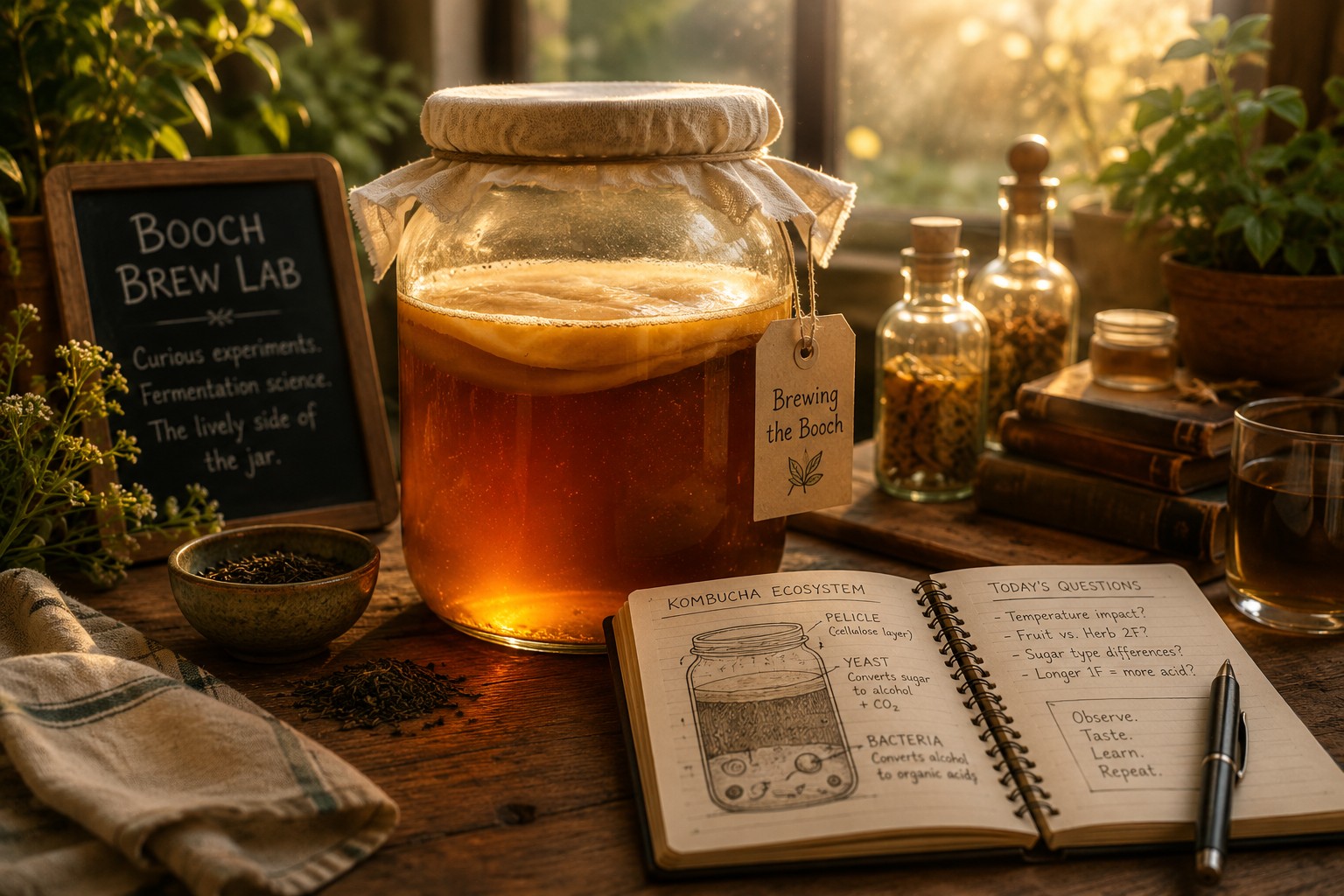
Welcome to the Microscopic City
Billions of bacteria and yeast are eating, reproducing, and transforming ordinary sweet tea into something completely different. Sugars are broken down. New acids form. Aromas develop. Carbon dioxide rises through the liquid in tiny bubbles.
All of this happens without anyone giving instructions, assigning jobs, or calling a meeting.
Brewing kombucha is less like making a conventional beverage and more like tending a tiny living ecosystem. We provide the tea, sugar, water, starter liquid, and a comfortable place to work. The culture handles the rest.
What Exactly Is a SCOBY?
SCOBY stands for Symbiotic Culture of Bacteria and Yeast.
Despite the name, a SCOBY is not one organism. It is a community of microorganisms living and working together. Different members of that community perform different jobs, and the products created by one group often become food for another.
Think of it as a neighborhood in which everyone has a specialty.
Meet the Residents
The Yeast
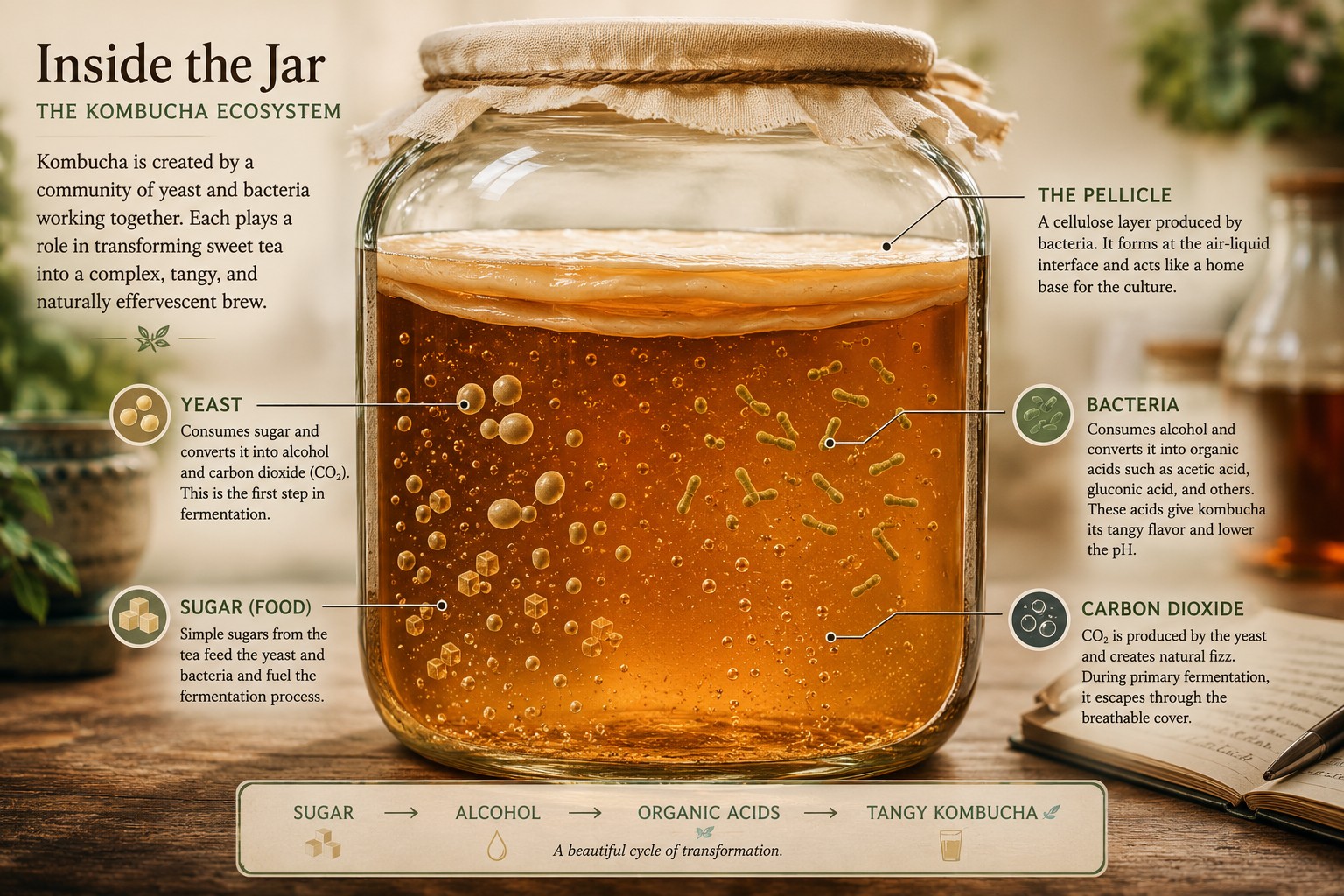
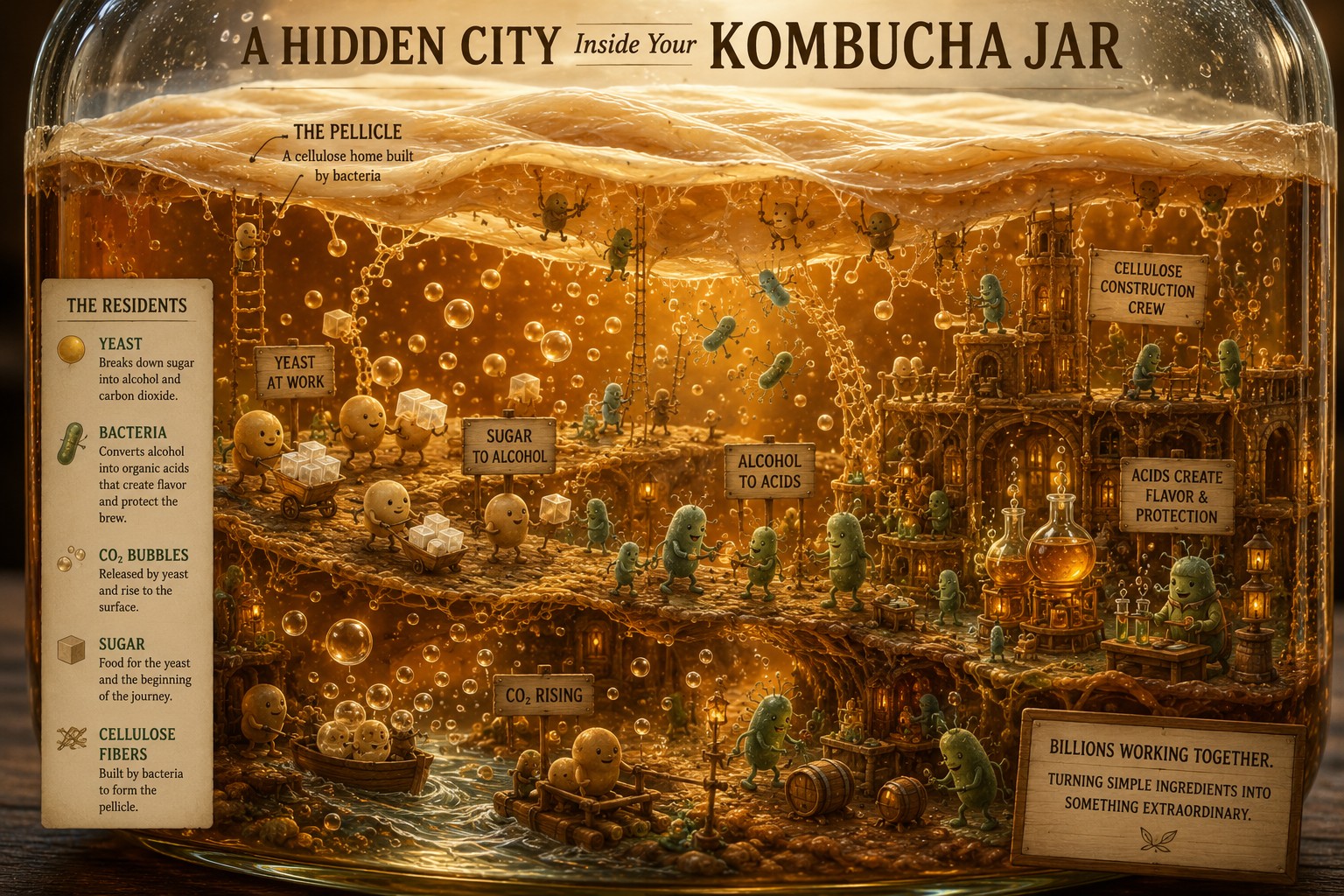
The yeast are among the first workers on the job. They break down sugars in the sweet tea and produce small amounts of alcohol and carbon dioxide.
The carbon dioxide may appear as tiny bubbles clinging to the glass, gathering beneath the pellicle, or rising through the liquid. Most of it escapes during primary fermentation because the jar is covered with breathable cloth rather than sealed with a lid.
The alcohol produced by the yeast does not simply remain untouched. It becomes raw material for the next group of residents.
The Bacteria
Several types of bacteria may live within a healthy kombucha culture. Some consume the alcohol produced by the yeast and convert it into organic acids, including acetic acid and gluconic acid.
These acids lower the pH of the brew and create kombucha’s characteristic tartness. As fermentation progresses, the tea usually becomes less sweet and increasingly bright, tangy, and acidic.
That acidic environment also makes healthy kombucha an uncomfortable place for many unwanted microorganisms.
The Pellicle Is Not the Whole SCOBY
Now we come to one of kombucha’s most persistent misunderstandings.
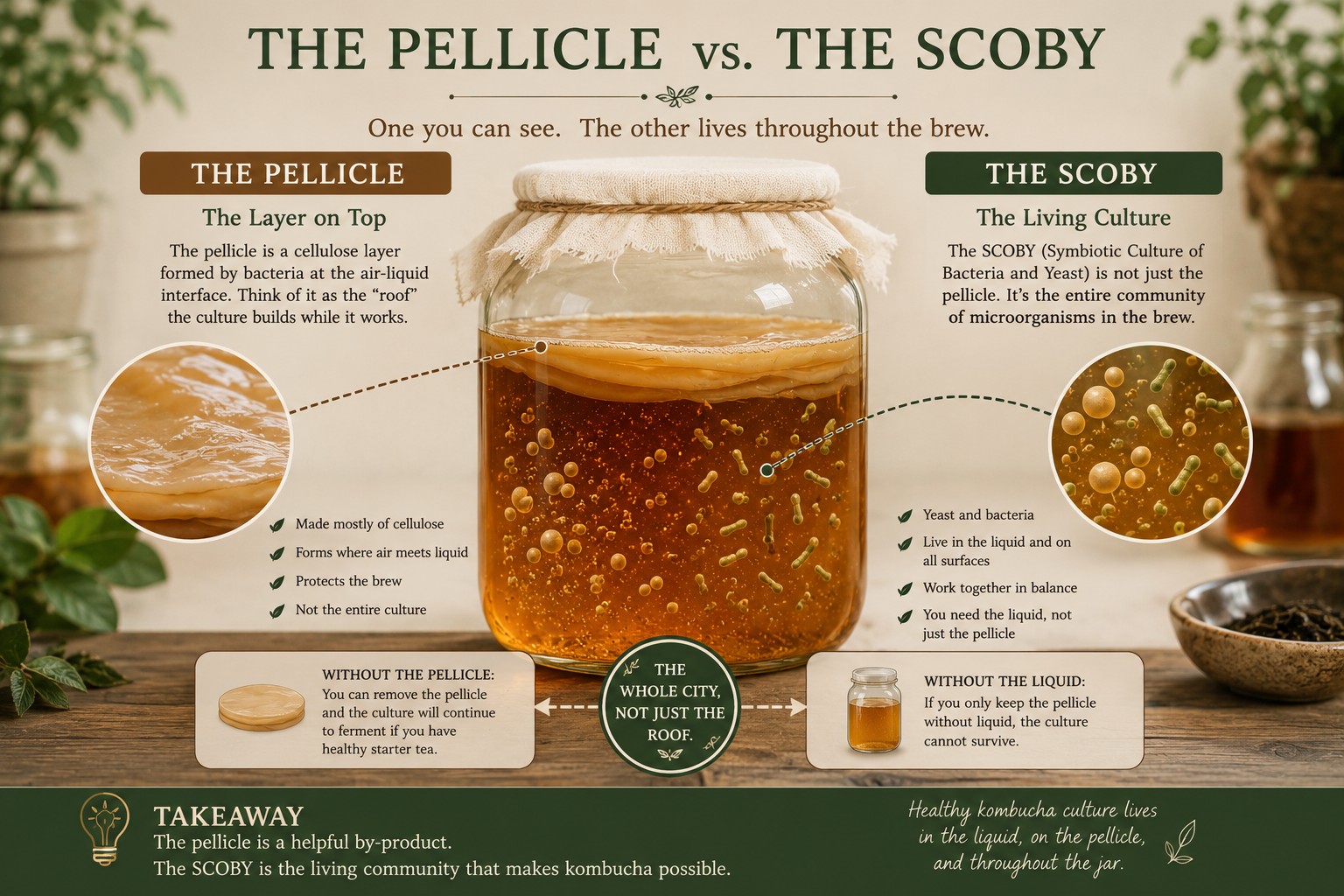
The pale, rubbery pancake floating near the surface is commonly called “the SCOBY.” In everyday conversation, most brewers know exactly what that means.
Technically, however, that solid layer is better described as the pellicle.
The pellicle is made largely of cellulose created by bacteria during fermentation. It forms where the liquid meets the air and may become thicker with each batch.
The living culture is not confined to that disk. Bacteria and yeast also live throughout the liquid, which is why mature starter tea is so important when beginning a new batch.
You can think of the pellicle as a structure the community builds while it works. The workers themselves are spread throughout the brew.
A Rough Fermentation Timeline
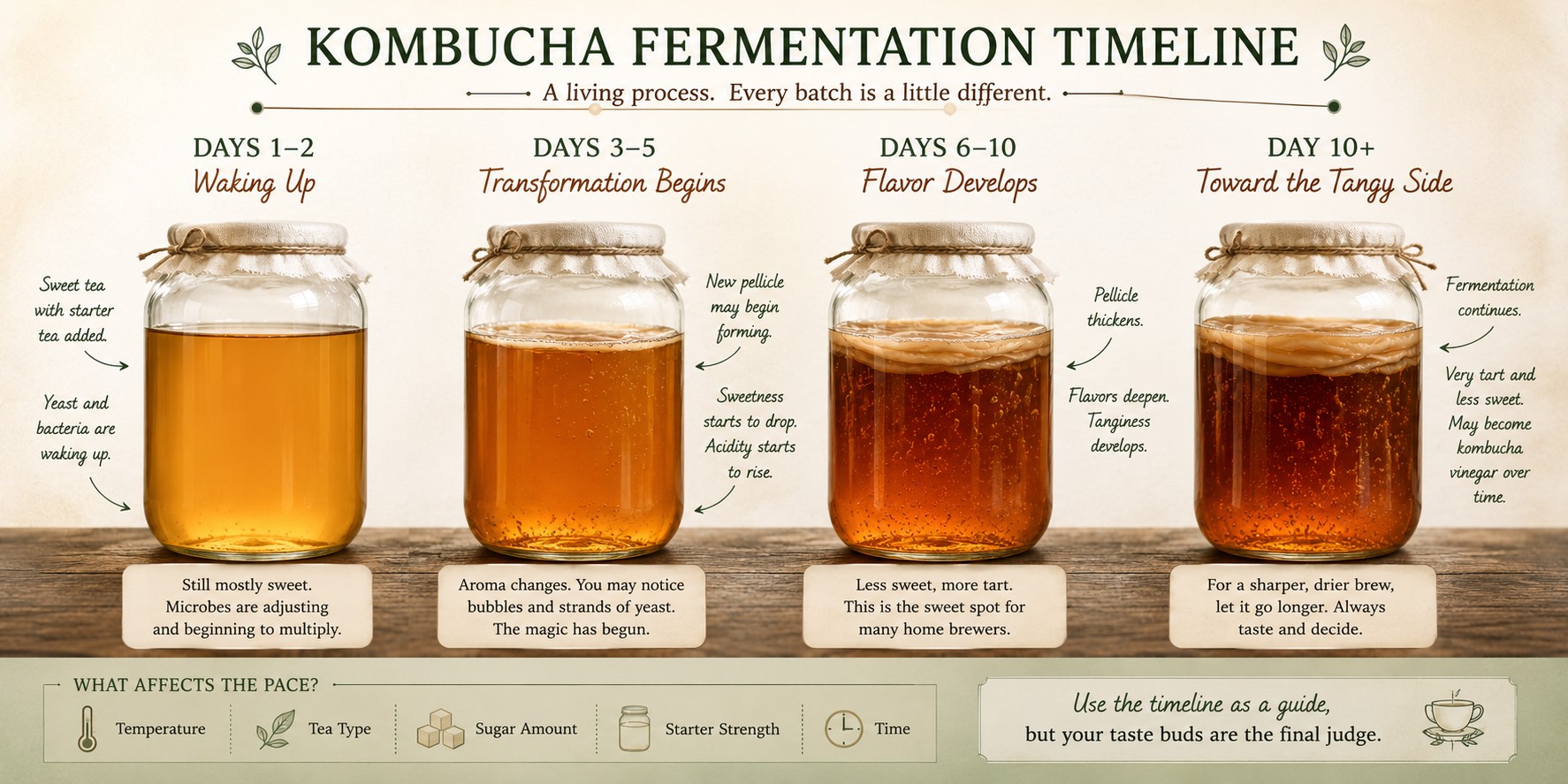
Every batch behaves a little differently. Tea, temperature, starter strength, sugar concentration, vessel shape, and the personality of the culture all influence the pace.
Still, a typical batch often follows a recognizable pattern.
Days 1–2: Waking Up
The jar may still taste mostly like sweet tea. The yeast and bacteria are adjusting to their new environment and beginning to multiply.
Visible activity may be limited, although a few bubbles or strands of yeast may appear.
Days 3–5: The Transformation Begins
Sweetness begins to decline and acidity starts to rise. The aroma may become fruitier, tangier, or slightly vinegary.
A thin, translucent film may begin forming across the surface. This is the beginning of a new pellicle.
Days 6–10: The Flavor Develops
The kombucha becomes less sweet and more tart. Its flavors begin to deepen, and the balance between sweetness and acidity becomes easier to recognize.
Many home brewers begin tasting regularly during this period.
Day 10 and Beyond: Toward the Tangy Side
If fermentation continues, the brew generally becomes sharper and less sweet. Left long enough, it may move away from a refreshing drinking kombucha and toward a strong kombucha vinegar.
The calendar offers guidance, but your taste buds make the final decision.
Why Temperature Matters So Much
Kombucha culture is alive, and living things respond to temperature.
In a warmer room, fermentation will usually move faster. Yeast and bacteria become more active, sugar disappears sooner, and acidity develops more quickly.
In a cooler room, the entire process slows down. A batch that tastes ready in seven days during summer may need considerably longer during winter.
This is one reason rigid brewing schedules can be misleading. The jar does not own a calendar. It responds to the conditions around it.
What Are Those Strange Things in the Jar?
A working kombucha jar is not always beautiful in the conventional sense.
You may see:
- Brown strings hanging beneath the pellicle
- Cloudy material collecting near the bottom
- Bubbles trapped under the surface
- Thin patches forming across the top
- Uneven, lumpy, or folded pellicle growth
These can all be normal signs of fermentation. Yeast strands, sediment, bubbles, and irregular cellulose growth are common in healthy batches.
Kombucha does not generally produce a flawless, perfectly white disk. It produces whatever shape the activity inside the jar happens to create.
The Remarkable Part
Fermentation itself is not unusual.
Bread ferments. Beer ferments. Wine ferments. Yogurt ferments. Cheese ferments. Pickles ferment.
What makes kombucha fascinating is the way a mixed community of microorganisms transforms such simple ingredients through a chain of cooperative activity.
The yeast break down sugars and produce alcohol. The bacteria use that alcohol and create acids. Some bacteria build cellulose at the surface. Carbon dioxide moves upward through the tea. The chemistry of the brew shifts day by day.
No foreman. No schedule. No quality-control meeting.
Just billions of tiny organisms doing what they have evolved to do.
The Brew Lab Takeaway
The next time you walk past your fermentation jar, do not think of it as merely a container of tea.
Think of it as a living city.
Inside, yeast and bacteria are processing sugar, creating acids, building cellulose, releasing bubbles, and changing the character of the brew hour by hour.
Your role is surprisingly modest. Provide clean equipment, properly sweetened tea, enough mature starter liquid, breathable cover, suitable temperature, and time.
Then resist the urge to micromanage the microbes.
They know what they are doing.
Observe the jar.
Trust the culture.
Let the Booch do its thing.