
Kombucha has been asked to carry an unreasonable amount of luggage.
Depending on which bottle, advertisement, or enthusiastic friend you encounter, it may be introduced as a probiotic, an antioxidant, a digestive tonic, a blood-sugar regulator, an immune booster, a liver cleanser, or a fizzy little cure for nearly everything that has ever gone wrong with the human body.
That is a great deal of responsibility for fermented tea.
The truth is more interesting than either the miracle claims or the eye-rolling dismissal. Kombucha contains biologically active ingredients. Human research has begun to find a few promising effects. But the evidence is still young, the studies are generally small, and different kombuchas can be remarkably different from one another.
So, is kombucha good for you?
Probably, in the modest way that a thoughtfully made food or drink can be good for you. Possibly in a few more specific ways. But it is not medicine, and it has not earned most of the superpowers printed on its cape.

The Honest Answer, Before We Enter the Lab
A 2019 systematic review searched hundreds of papers and found only one study that had examined kombucha in human participants. At that point, nearly all of the impressive claims came from test tubes, laboratory assays, animal experiments, traditional use, or repetition on the internet.[1]
The field has moved forward since then. A 2025 systematic review identified eight human clinical trials, including six randomized controlled trials. Some reported improvements in gastrointestinal symptoms, modest changes in gut or salivary microbiota, and possible effects on glucose metabolism. The trials, however, lasted only 10 days to 10 weeks, used different kinds of kombucha, measured different outcomes, and often involved small groups of participants.[2]
That means the fairest current answer is neither “kombucha is a miracle” nor “kombucha does nothing.”
It means the early human evidence is promising in places, inconsistent in others, and nowhere near strong enough to support sweeping medical claims.
Why Kombucha Could Have Health Effects
Kombucha is not ordinary sweet tea after fermentation. The Hidden City changes the neighborhood.
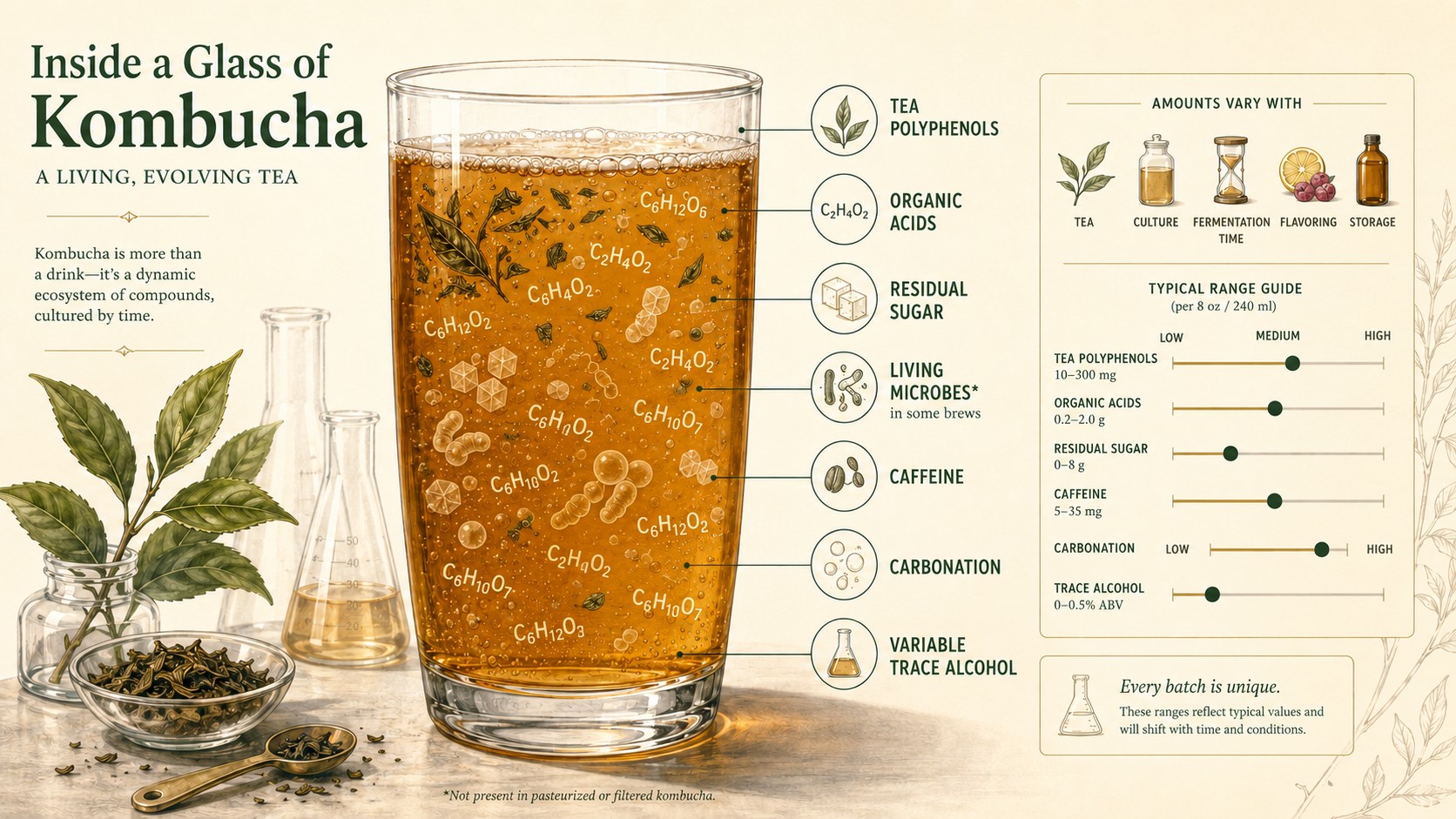
Yeast break down sugars and produce alcohol and carbon dioxide. Acetic acid bacteria use some of that alcohol to create organic acids. The tea begins with polyphenols and other plant compounds, while the fermentation introduces a changing mixture of acids, metabolites, microbes, and aromatic compounds.
Any of those ingredients could plausibly influence the body. Plausibility, however, is only the first step.
A substance can neutralize free radicals in a laboratory dish without producing a meaningful health benefit in a person. A microbe can be alive in a bottle without surviving digestion or improving health. A compound can slow the growth of bacteria in a test tube without treating an infection inside the human body.
Laboratory findings tell researchers where to look. Human clinical trials tell us whether the effect actually travels beyond the lab bench.

Is Kombucha Really a Probiotic?
This is one of those questions with an annoyingly precise scientific answer.
Many raw kombuchas contain living microorganisms. That does not automatically make every kombucha a proven probiotic.
The National Institutes of Health defines probiotics as live microorganisms that provide a health benefit when consumed in sufficient amounts. The specific genus, species, strain, and dose matter. A fermented food may contain live microbes without having demonstrated that those particular microbes, in that particular quantity, produce a particular benefit.[3]
Kombucha cultures also vary. Tea type, starter culture, fermentation temperature, time, bottling, refrigeration, filtering, and pasteurization can all change what remains in the finished drink.
So it is reasonable to describe unpasteurized kombucha as a live fermented beverage. Calling it a probiotic with a known health effect requires more specific evidence than most home brews or commercial labels provide.
What About Digestion and the Gut Microbiome?
This may be kombucha’s most believable health claim, but the results are still more subtle than the marketing.
In a 10-week randomized trial, adults with excess body weight followed an energy-restricted diet. One group also drank 200 milliliters of green tea kombucha each day. The kombucha group reported fewer gastrointestinal symptoms related to intestinal motility, but researchers did not find a significant improvement in gut microbiota composition or intestinal permeability compared with the control group.[4]
Another controlled study followed 24 healthy adults eating a Western-style diet. After four weeks of kombucha consumption, researchers observed modest changes in the relative abundance of some gut microorganisms. They did not find broad improvements in biochemical measures or circulating inflammatory markers across the full group.[5]
Those findings matter. They suggest kombucha may interact with the digestive ecosystem. They do not prove that it permanently “repopulates the gut,” repairs a damaged microbiome, or treats digestive disease.
The Hidden City in the jar may send visitors through the Hidden City in your intestines. Whether those visitors settle down, change the local economy, or simply pass through remains an active research question.

Can Kombucha Help Control Blood Sugar?
This is one of the more intriguing areas of human research.
In a randomized crossover trial involving 11 healthy adults, participants ate a high-glycemic meal with soda water, a diet soft drink, or unpasteurized kombucha. The meal consumed with kombucha produced a lower glycemic and insulin response than the same meal consumed with soda water. The study was carefully designed, but it measured the response to a single meal in a very small group.[6]
A separate pilot trial enrolled 12 adults with type 2 diabetes, although only seven completed all of the blood-glucose measurements needed for the primary analysis. Participants drank 240 milliliters of kombucha or a placebo beverage daily for four weeks, crossed over after a washout period, and then consumed the other drink. Fasting glucose fell during the kombucha period compared with baseline, but the week-four difference between the kombucha and placebo groups was not statistically significant in the full analysis.[7]
That is a signal worth investigating—not a treatment recommendation.
People with diabetes should not use a small kombucha study as a reason to change medication, increase sugar intake, or stop monitoring blood glucose. Different kombuchas contain different amounts of residual sugar, acids, alcohol, and flavoring ingredients. A bottle is not interchangeable with a clinical trial.
Antioxidants, Inflammation, and Heart Health
Kombucha made from true tea begins with tea polyphenols, which are frequently described as antioxidants. Fermentation can change the form and concentration of some compounds, and many kombuchas show antioxidant activity in laboratory testing.
The human question is whether drinking the beverage produces a meaningful improvement in health.
A 10-week randomized trial of green tea kombucha in adults with excess body weight found a reduction in one pro-oxidant marker, but it did not produce broad changes across the other measures of oxidative stress or endothelial health that were evaluated.[8]
Another analysis from the same broader intervention found that both the control group and the kombucha group lost weight and body fat while following an energy-restricted diet. Kombucha did not increase weight loss. Some inflammatory and salivary microbiota measurements differed between groups, but the results were not a sweeping anti-inflammatory transformation.[9]
A 2026 randomized trial using the same general dietary setting reported improvements from baseline in several lipid markers among participants drinking 200 milliliters of green tea kombucha daily. However, when the total change in the kombucha group was compared directly with the control group, the between-group differences were not statistically significant for the evaluated markers.[10]
This is a perfect example of why study headlines require care. A group can improve from where it started without proving that the tested product caused more improvement than the comparison treatment.
Does Kombucha Detox the Body?
No credible human evidence shows that kombucha “flushes toxins,” cleanses the liver, or performs a special detoxification service.
Your liver, kidneys, lungs, digestive tract, and skin already handle the body’s ordinary waste-processing work. Kombucha may contain interesting acids and plant compounds, but that does not turn the beverage into a municipal cleanup crew for the bloodstream.
The Most Practical Benefit May Be What Kombucha Replaces
Sometimes the healthiest feature of a drink is not a mysterious compound. It is the beverage you did not drink instead.
A pleasantly tart kombucha with moderate residual sugar may replace a much sweeter soda, a large sweet tea, or an alcoholic drink. That can be a sensible trade. But the advantage comes from the full comparison: serving size, sugar, calories, alcohol, caffeine, and how often you drink it.
A heavily sweetened kombucha is still heavily sweetened. A bottle flavored with juice may contain more sugar than expected. A home brew may continue fermenting after bottling and develop more alcohol than the brewer intended.
The nutrition label—and in home brewing, careful process control—deserves at least as much attention as the word fermented.
Who Should Be Careful?
Most healthy adults can likely enjoy modest amounts of properly prepared kombucha without difficulty. That does not make every batch appropriate for every person.
Kombucha is acidic. It may contain caffeine, residual sugar, living microorganisms, and variable amounts of alcohol. Home brewing introduces additional risks when sanitation is poor, mold is ignored, or the beverage is stored in reactive containers.
A CDC investigation of two severe illnesses in 1995 did not establish that kombucha caused the illnesses, but it highlighted the uncertainty surrounding excessive consumption, medically vulnerable drinkers, contamination, and the danger of storing acidic kombucha in ceramic or lead-crystal vessels that can leach toxic elements.[11]
Medical institutions commonly advise pregnant or breastfeeding people and those with weakened immune systems to avoid kombucha or discuss it with a healthcare professional. Anyone with a significant medical condition, medication concern, or sensitivity to caffeine, sugar, acidity, or alcohol should make the same call.[12]
So, Should You Drink It?
If you enjoy kombucha, tolerate it well, and brew or buy it responsibly, there is no need to wait for a medical miracle before pouring a glass.
Drink it because it is tart, aromatic, refreshing, and endlessly interesting. Enjoy the tea polyphenols, fermentation products, and possible live cultures without asking them to carry the entire burden of your health.
The early research gives us good reasons to keep studying digestion, microbial changes, glucose response, inflammation, and cardiometabolic markers. It does not give us permission to turn every promising mechanism into a promise.
Kombucha can be a good beverage without being a cure.
In fact, that may be the healthiest way to think about it.
References
- Kapp, J. M., & Sumner, W. “Kombucha: A Systematic Review of the Empirical Evidence of Human Health Benefit.” Annals of Epidemiology, 30, 66–70 (2019). doi:10.1016/j.annepidem.2018.11.001
- Fraiz, G. M., et al. “Benefits of Kombucha Consumption: A Systematic Review of Clinical Trials Focused on Microbiota and Metabolic Health.” Fermentation, 11(6), 353 (2025). doi:10.3390/fermentation11060353
- National Institutes of Health, Office of Dietary Supplements. “Probiotics: Fact Sheet for Health Professionals.” NIH Office of Dietary Supplements
- Fraiz, G. M., et al. “The Impact of Green Tea Kombucha on the Intestinal Health, Gut Microbiota, and Serum Metabolome of Individuals with Excess Body Weight in a Weight Loss Intervention: A Randomized Controlled Trial.” Foods, 13(22), 3635 (2024). doi:10.3390/foods13223635
- Ecklu-Mensah, G., et al. “Modulating the Human Gut Microbiome and Health Markers Through Kombucha Consumption: A Controlled Clinical Study.” Scientific Reports, 14, 31647 (2024). doi:10.1038/s41598-024-80281-w
- Atkinson, F. S., Cohen, M., Lau, K., & Brand-Miller, J. C. “Glycemic Index and Insulin Index After a Standard Carbohydrate Meal Consumed with Live Kombucha: A Randomised, Placebo-Controlled, Crossover Trial.” Frontiers in Nutrition, 10, 1036717 (2023). doi:10.3389/fnut.2023.1036717
- Mendelson, C., et al. “Kombucha Tea as an Anti-Hyperglycemic Agent in Humans with Diabetes: A Randomized Controlled Pilot Investigation.” Frontiers in Nutrition, 10, 1190248 (2023). doi:10.3389/fnut.2023.1190248
- Bonifácio, D. B., et al. “Effect of Regular Green Tea (Camellia sinensis) Kombucha Consumption on Oxidative Stress and Endothelial Health in Individuals with Excess Body Weight: A Randomized Controlled Trial.” British Journal of Nutrition (2025). doi:10.1017/S0007114525103838
- Fraiz, G. M., et al. “Green Tea Kombucha Impacts Inflammation and Salivary Microbiota in Individuals with Excess Body Weight: A Randomized Controlled Trial.” Nutrients, 16(18), 3186 (2024). doi:10.3390/nu16183186
- Bonifácio, D. B., et al. “Effect of Green Tea Kombucha Within an Energy-Restricted Diet on Cardiometabolic Risk Markers in Individuals with Excess Body Weight: A Randomized Controlled Trial.” Journal of Food Science, 91(4), e71050 (2026). doi:10.1111/1750-3841.71050
- Centers for Disease Control and Prevention. “Unexplained Severe Illness Possibly Associated with Consumption of Kombucha Tea—Iowa, 1995.” Morbidity and Mortality Weekly Report, 44(48), 892–900 (1995). CDC MMWR report
- Mayo Clinic. “Kombucha Tea: Does It Have Health Benefits?” Updated September 26, 2024. Mayo Clinic
Drink it because you enjoy it.
Brew it because it fascinates you.
Let the evidence catch up with the legend.