
Kombucha begins with sweet tea. Not faintly sweet tea. Not tea that once heard someone mention sugar from across the room. Properly sweet tea.
Then we add a living culture, wait a week or two, and pour ourselves something tart, bright, and unmistakably fermented.
That naturally raises a question.
Where did all the sugar go?
The reassuring answer is that the microbes ate some of it. The less reassuring answer is that they probably did not eat all of it, and without laboratory testing, your taste buds, calendar, and inexpensive Brew Lab gadgets cannot tell you exactly how much remains.
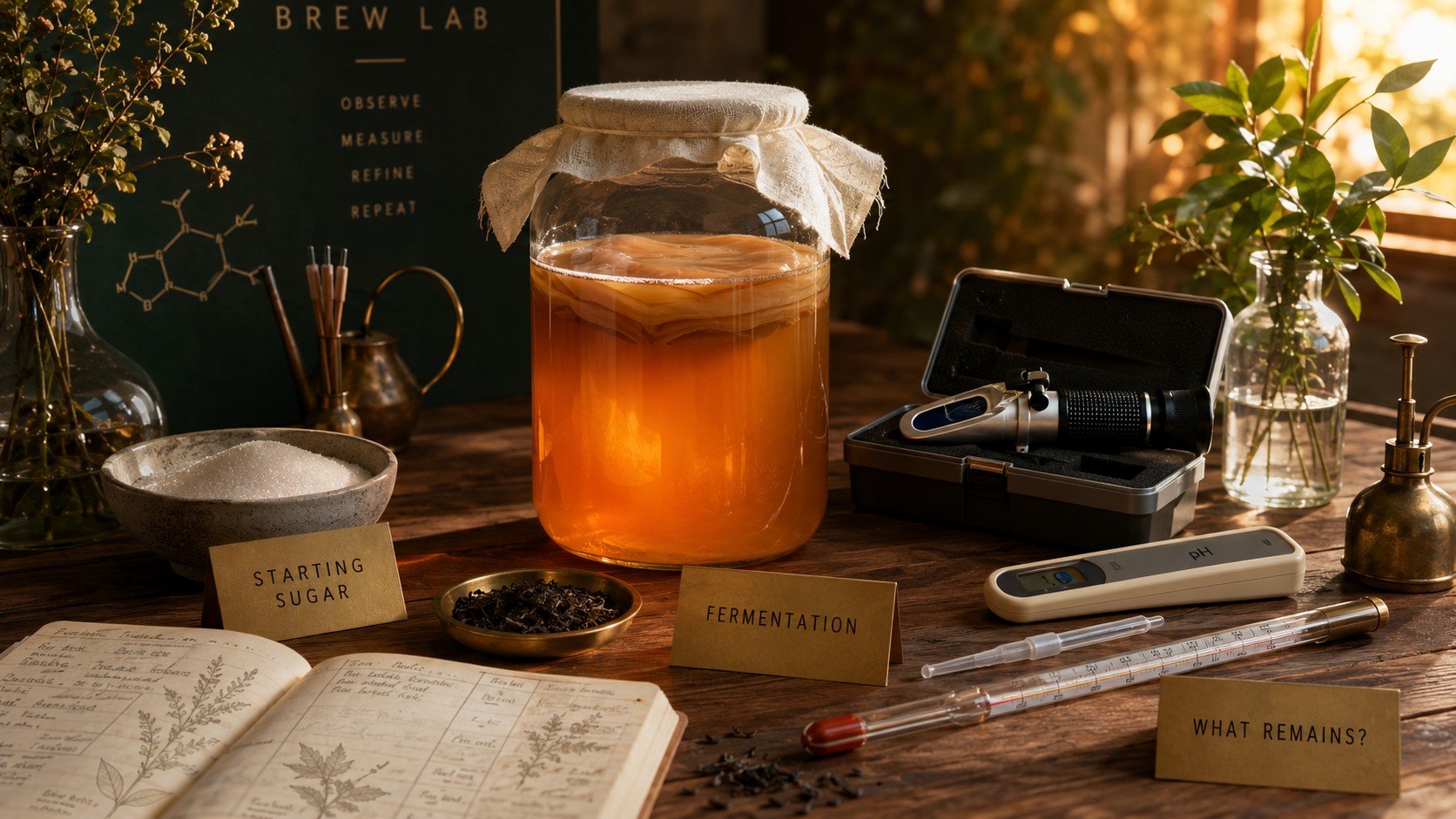
Sugar Is Not an Embarrassing Ingredient
Sugar sometimes gets discussed as though it were an unfortunate contaminant that somehow wandered into the recipe.
It did not wander in. We invited it.
Sugar is the primary fuel that allows the kombucha culture to do its work. Without a suitable carbohydrate source, the yeast have very little to ferment, the bacteria receive less of the alcohol and sugars they use to make acids, and the whole operation becomes less of a fermentation and more of a jar of tea waiting for something to happen.
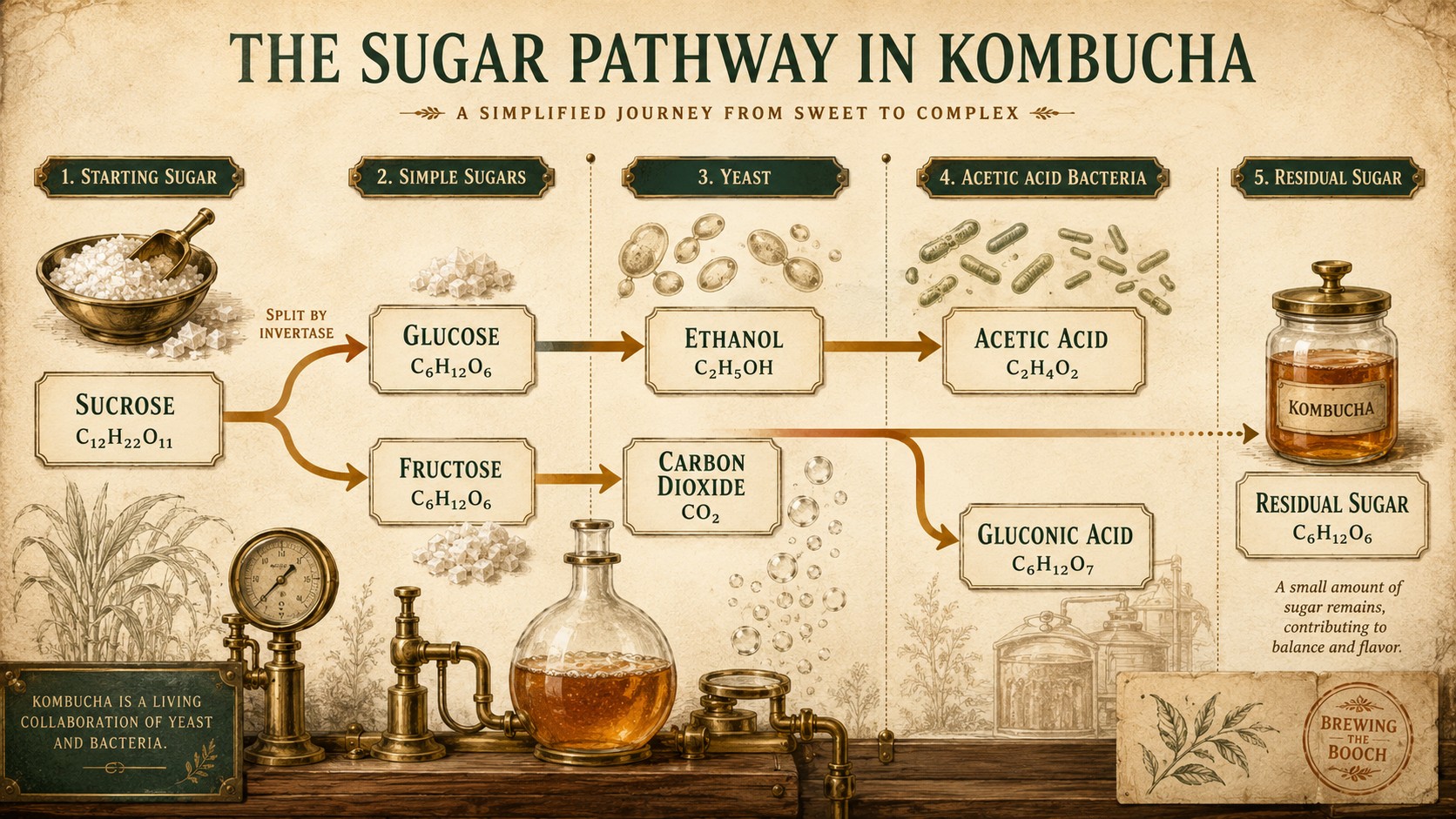
Traditional kombucha commonly begins with sucrose, the ordinary table sugar represented by the formula C12H22O11. Yeast-produced invertase breaks sucrose apart into the simpler sugars glucose and fructose. Those sugars then enter a network of microbial reactions that produces ethanol, carbon dioxide, organic acids, cellulose, flavor compounds, and new microbial biomass.
So the sugar does not simply disappear. It changes jobs.
The Simplified Version of What Happens
The full chemistry inside a mixed kombucha culture is complicated, but the general sequence is understandable.
Step 1: Sucrose Is Split
Yeast enzymes split sucrose into glucose and fructose. This does not reduce the total sugar immediately. One larger sugar has simply become two smaller sugars.
Step 2: Yeast Ferment the Simple Sugars
Yeast consume some of the glucose and fructose and produce ethanol and carbon dioxide. During F1, much of that carbon dioxide escapes through the breathable cover. In a sealed F2 bottle, more of it remains trapped and becomes carbonation.
Step 3: Bacteria Continue the Hand-Off
Acetic acid bacteria oxidize ethanol into acetic acid. Some members of the culture can also convert glucose into gluconic acid and related compounds. Other products and pathways may be present depending on the organisms in the culture and the brewing conditions.
Step 4: Some Sugar Remains
The culture does not generally consume every available molecule before the kombucha reaches a flavor most people want to drink. A pleasant batch usually retains some sweetness to balance the growing acidity.
Fermented Does Not Mean Sugar-Free
This is the part worth putting in large letters on the laboratory wall.
Fermented does not mean sugar-free.
The word fermented tells you that microorganisms have transformed some of the ingredients. It does not tell you that every fermentable sugar has been consumed.
A brewer can start two jars with the same recipe and finish with different residual sugar because of differences in:
- Culture composition and health
- Starter strength
- Fermentation temperature
- Fermentation time
- Tea composition
- Oxygen availability
- Vessel shape and liquid depth
- Starting sugar concentration
- Fruit, juice, puree, syrup, or other F2 additions
Kombucha recipes are repeatable enough to be useful, but the Hidden City is not a factory operating under pharmaceutical controls.
Tartness Is Not a Sugar Meter
A very tart kombucha can still contain meaningful residual sugar.
Sweetness and acidity are not opposite ends of a single dial. They are separate components that your senses experience together. As organic acids accumulate, they can mask sweetness and make the beverage taste much drier than its actual sugar content would suggest.
This is why tasting is excellent for deciding when you enjoy the brew but poor for calculating how many grams of sugar remain.
Your tongue can tell you, “This is balanced,” “This needs another day,” or “We have crossed into salad-dressing territory.” It cannot produce a nutrition label.
Then F2 Adds More Sugar to the Story
Suppose your F1 has reached exactly the balance you want. Then you add cranberry juice, mango puree, agave nectar, simple syrup, berries, or another flavoring and seal the bottle.
You have just funded another round of fermentation.
Some of that new sugar may be consumed by the yeast and converted into carbon dioxide and ethanol. Some may remain when the bottle goes into the refrigerator. The amount depends on the sugar source, temperature, time, yeast activity, and how quickly refrigeration slows the process.
Zero-sugar flavorings add another wrinkle. They may contribute flavor without providing much fermentable food. If the F1 is already fairly dry and the F2 addition contains no usable sugar, the yeast cannot produce substantial carbonation out of optimism.
That does not make zero-sugar flavoring wrong. It simply means carbonation may require a separate measured sugar addition.
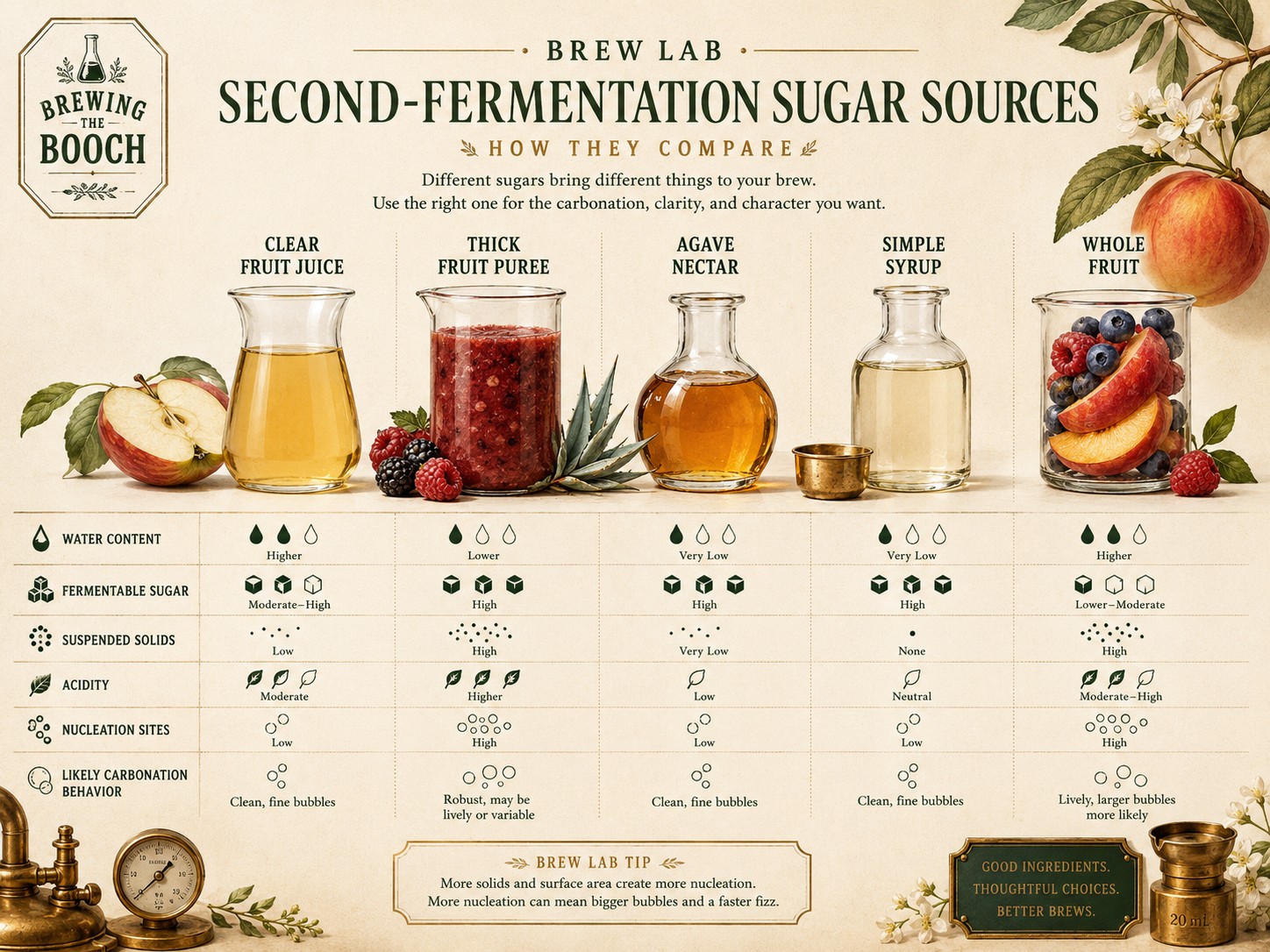
Juice, Puree, Agave, and Syrup Are Not Interchangeable
A tablespoon of one sweetener is not automatically equivalent to a tablespoon of another.
Fruit juice contains water, natural sugars, acids, and dissolved plant compounds. Puree adds those things along with pulp, fiber, and suspended solids. Agave nectar and simple syrup are more concentrated sugar sources. Whole fruit contributes sugar unevenly as its cells break down.
They also affect what you observe. Puree can provide nucleation sites and foam-stabilizing solids, making carbonation look much more dramatic when a bottle opens. A clear juice batch may contain plenty of dissolved carbon dioxide while behaving with better manners.
That is why “I added two tablespoons” is only useful when the next sentence says two tablespoons of what.
Can a Refractometer Tell You How Much Sugar Is Left?
This is where a perfectly respectable little instrument enters the Brew Lab and immediately becomes more complicated than the box suggests.
A Brix refractometer measures how strongly a liquid bends light. In a simple solution of sugar and water, that reading can be converted into an estimate of dissolved sugar concentration. Before fermentation, this is genuinely useful.
You can measure:
- Your freshly prepared sweet tea
- The same tea after starter liquid is added
- Juices, syrups, and other F2 additions
- Repeated batches made from the same recipe
Once fermentation begins, however, the refractometer is no longer looking at simple sugar water. It is looking at a changing mixture containing sugars, ethanol, organic acids, dissolved solids, and fermentation products. All of those can influence the refractive index.
Beer and wine brewers use correction formulas because alcohol distorts post-fermentation refractometer readings. Kombucha adds another layer of uncertainty because its bacteria are also producing significant organic acids and other metabolites. A beer correction calculator does not magically turn a fermented kombucha reading into an exact residual-sugar result.
That does not make the refractometer useless. It changes the question it can responsibly answer.
It is good at answering:
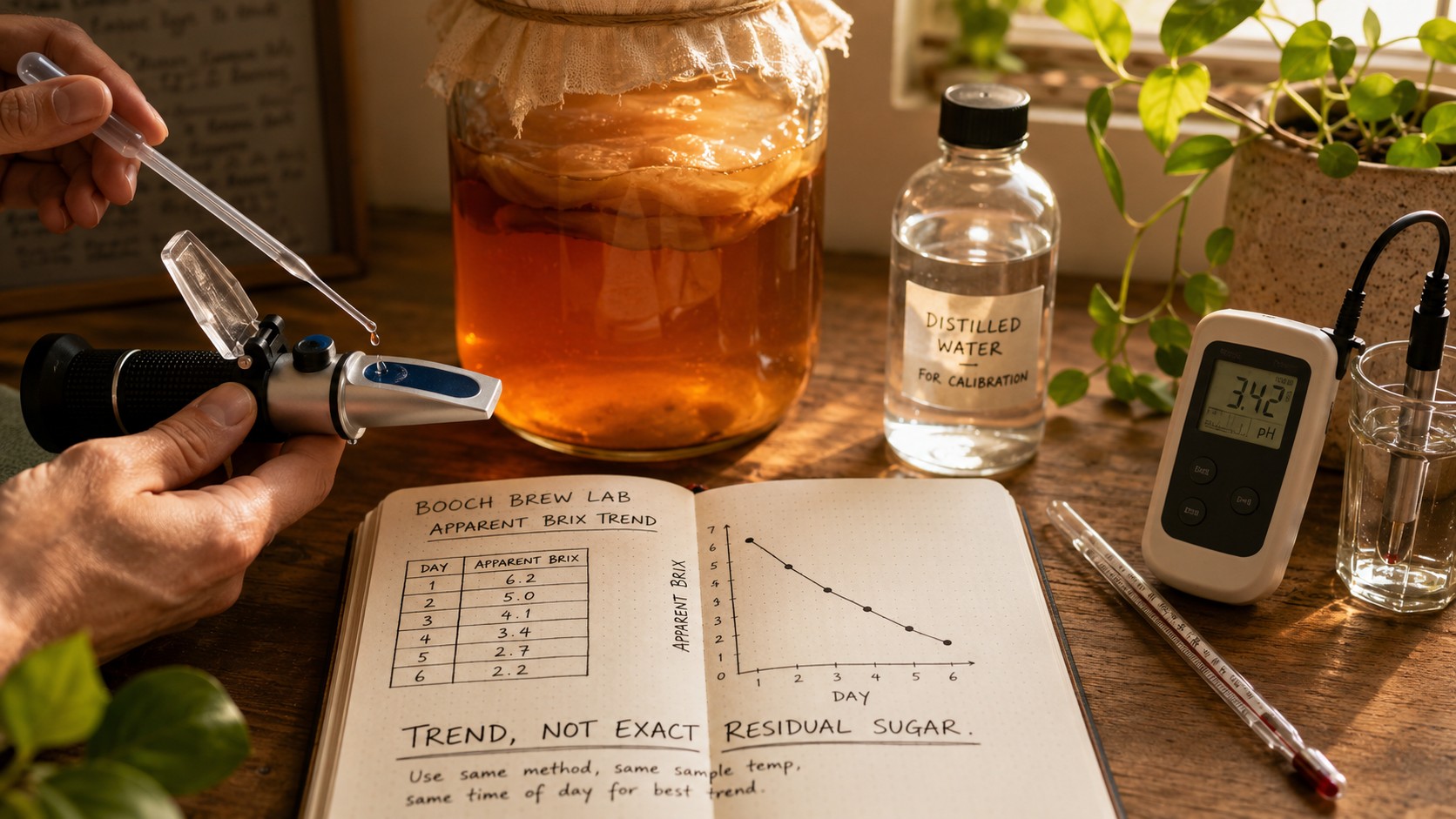
Is this batch changing, and how does its apparent Brix trend compare with my other batches?
It is not good at answering:
Exactly how many grams of sugar are in this finished glass?
What the Dual Specific-Gravity Scale Really Means
Many inexpensive brewing refractometers include both Brix and specific-gravity scales.
The second scale may look as though the instrument is performing two independent measurements. It is not. Both scales come from the same optical reading. The specific-gravity value is a conversion based on assumptions that work best for an unfermented sugar solution.
After alcohol and acids appear, that printed specific-gravity scale becomes increasingly questionable.
For kombucha work, I would record the Brix reading and describe fermented samples as apparent Brix. That wording reminds us that the number reflects the whole liquid, not sugar alone.
ATC HelpsBut It Does Not Perform Miracles
Automatic temperature compensation sounds more powerful than it is.
ATC helps the instrument compensate for changes in the refractometer itself within its intended temperature range. It does not instantly correct a hot sample, remove alcohol, subtract organic acids, filter out pulp, or interpret the sociology of your particular SCOBY.
Use a small, reasonably clear sample at approximately room temperature. Calibrate the refractometer with distilled water. Keep the prism clean. Record the conditions along with the number.
A precise-looking number collected carelessly is still a careless number.
The Booch Bench Method
For a practical homebrew experiment, I would track several measurements rather than expecting one instrument to explain the entire jar.
| Measurement | What It Helps Show | What It Does Not Prove |
|---|---|---|
| Apparent Brix | Changes in soluble composition and batch-to-batch trends | Exact residual sugar after fermentation begins |
| pH | Hydrogen-ion activity and general acidification trend | Total acid concentration or sugar content |
| Titratable acidity | Total neutralizable acidity | Exact identity of every acid present |
| Temperature | The conditions affecting microbial activity | How quickly every culture will ferment |
| Taste | Whether you actually enjoy the kombucha | A quantitative chemical analysis |
Record the original sweet tea before adding starter, then record the diluted starting brew after the starter is added. Take small samples at consistent intervals. Write down temperature, apparent Brix, pH, aroma, and taste.
The resulting numbers will not give you a laboratory nutrition panel, but they can tell a very useful story about how your own culture behaves.
Can You Brew Lower-Sugar Kombucha?
Yes, within reason, but the obvious shortcuts are not always good ones.
Starting with drastically less sugar may weaken fermentation, alter the microbial balance, and produce a thin or poorly acidified brew. Extending F1 generally reduces sweetness, but eventually the kombucha moves toward vinegar. Adding less sugar during F2 can reduce residual sweetness and pressure, but it may also reduce carbonation.
The more reliable approach is controlled moderation:
- Use a proven F1 recipe rather than starving the culture.
- Allow F1 to reach a drier flavor you still enjoy.
- Measure concentrated F2 sweeteners instead of pouring by instinct.
- Use unsweetened fruit or zero-sugar flavorings when appropriate, with a small measured fermentable sugar addition if carbonation is desired.
- Keep the process consistent enough that your own brew log becomes meaningful.
The goal is not to defeat the microbes. The goal is to give them enough fuel to do their work without leaving more sweetness than you want to drink.
What About Commercial Nutrition Labels?
Commercial kombucha is a finished packaged product made under controlled conditions, and its nutrition label is the best available guide for that specific bottle.
It is not a universal kombucha conversion chart.
Two commercial products can differ because of recipe, fermentation, filtration, pasteurization, juice additions, serving size, and post-fermentation sweetening. A homebrew made with a different culture and process cannot borrow the sugar number from a vaguely similar bottle at the grocery store.
For homebrew, an exact residual-sugar measurement generally requires analytical methods beyond the ordinary kitchen bench, such as chromatography or validated enzymatic assays.
The refractometer may look scientific, and to be clear, it is a scientific instrument, but science also means knowing what an instrument cannot tell you.
The Brew Lab Takeaway
Some of the starting sugar is consumed. Some becomes ethanol, carbon dioxide, acids, cellulose, biomass, and flavor compounds. Some remains in the finished kombucha. More may be added for F2, and some of that may remain as well.
Fermentation changes sugar. It does not issue a certificate declaring the bottle sugar-free.
A refractometer is still a worthwhile addition to the Booch Bench. It uses only a few drops, gives repeatable apparent-Brix readings, and can reveal trends across time and between batches. Pair it with pH, temperature, careful notes, and your own taste observations, and it becomes genuinely useful.
Just do not ask it to be a laboratory it was never designed to replace.
References & Further Reading
- Wang, B., Rutherfurd-Markwick, K., Zhang, X.-X., & Mutukumira, A. N. (2022). Kombucha: Production and Microbiological Research. Foods, 11(21), 3456. https://doi.org/10.3390/foods11213456
- Tran, T., Grandvalet, C., Verdier, F., et al. (2020). Microbial Dynamics between Yeasts and Acetic Acid Bacteria in Kombucha: Impacts on the Chemical Composition of the Beverage. Foods, 9(7), 963. https://doi.org/10.3390/foods9070963
- Chen, C., & Liu, B. Y. (2000). Changes in major components of tea fungus metabolites during prolonged fermentation. Journal of Applied Microbiology, 89(5), 834–839. https://doi.org/10.1046/j.1365-2672.2000.01188.x
- Villarreal-Soto, S. A., Beaufort, S., Bouajila, J., Souchard, J.-P., & Taillandier, P. (2018). Understanding Kombucha Tea Fermentation: A Review. Journal of Food Science, 83(3), 580–588. https://doi.org/10.1111/1750-3841.14068
- Hata, N. N. Y., et al. (2023). Role of Acetic Acid Bacteria in Food and Beverages. Fermentation, 9(4), 389. https://doi.org/10.3390/fermentation9040389
- Cohen, G., et al. (2023). Sucrose Concentration and Fermentation Temperature Impact the Sensory Characteristics and Liking of Kombucha. Foods, 12(16), 3116. https://doi.org/10.3390/foods12163116
Measure the trend.
Taste the balance.
Do not interrogate the refractometer.