
Burping may be considered polite in some cultures. In the carbonated kombucha community, however, it is usually a sign that somebody has been opening the bottle too often.
Second fermentation is where the bubbles are supposed to happen. The yeast are still at work, the bottle is sealed, and the carbon dioxide they produce can no longer escape into the room. That trapped gas dissolves into the liquid, and when all goes well, your kombucha becomes lively, sparkling, and deeply satisfying.
When all does not go well, you usually get one of two outcomes. Either the bottle opens with all the excitement of weak tea, or it erupts with enough enthusiasm to shame every fifth-grade science-fair vinegar-and-baking-soda volcano ever assembled.
Somewhere between disappointing flatness and repainting the kitchen ceiling lies the kombucha most of us are trying to make.

Carbonation Is Yeast With Nowhere to Go
The first thing worth clearing up is that kombucha carbonation is mostly a yeast story.
During primary fermentation, yeast break down sugars and produce carbon dioxide and alcohol. In an open or cloth-covered jar, most of that gas escapes. That is why a healthy F1 may show activity without becoming especially fizzy.
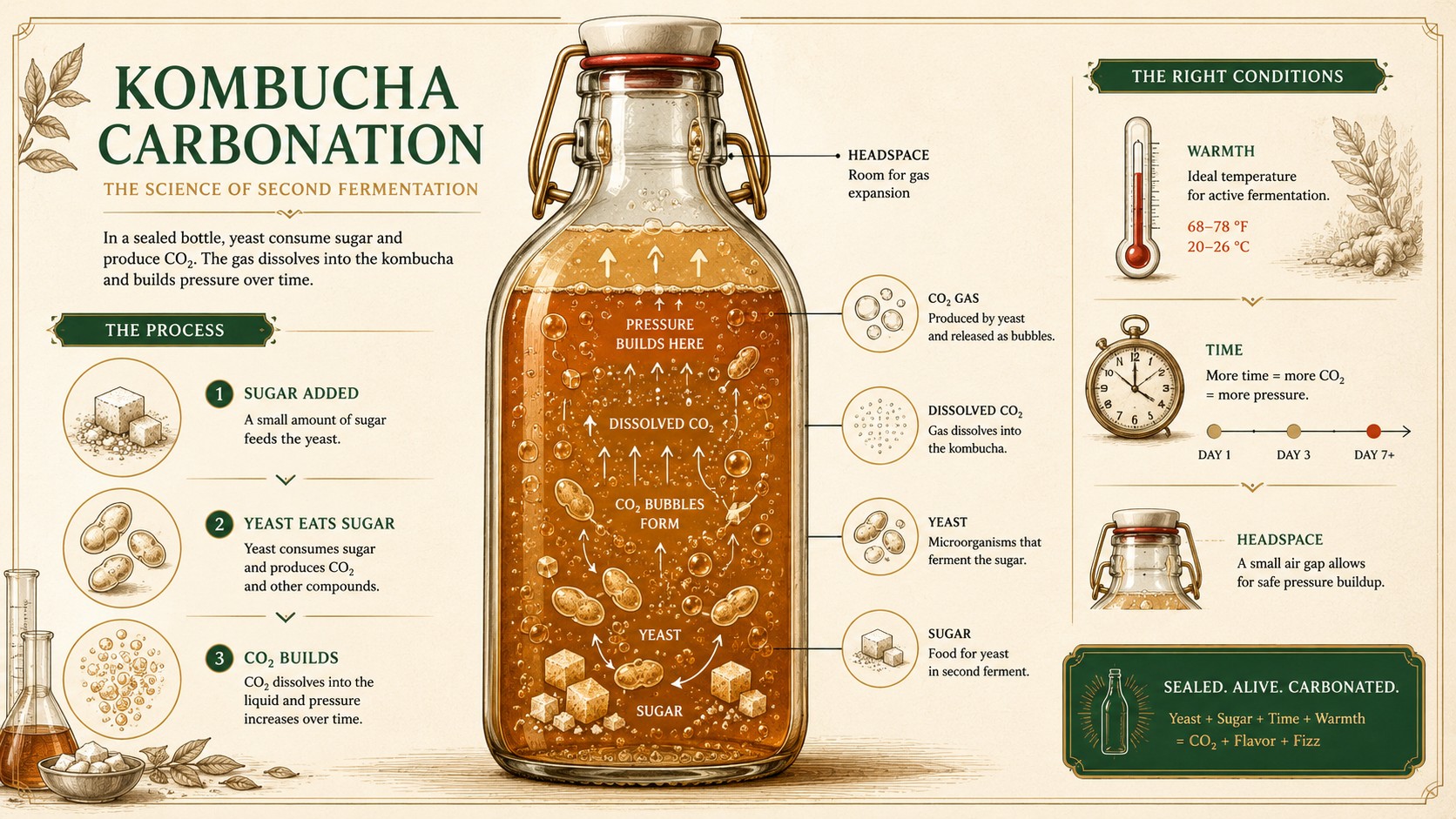
In second fermentation, the rules change. You move the kombucha into a sealed bottle, often with a little additional sugar from fruit, juice, syrup, or other flavorings. The yeast continue to work, but now the carbon dioxide has nowhere to go. It builds pressure in the bottle and dissolves into the liquid.
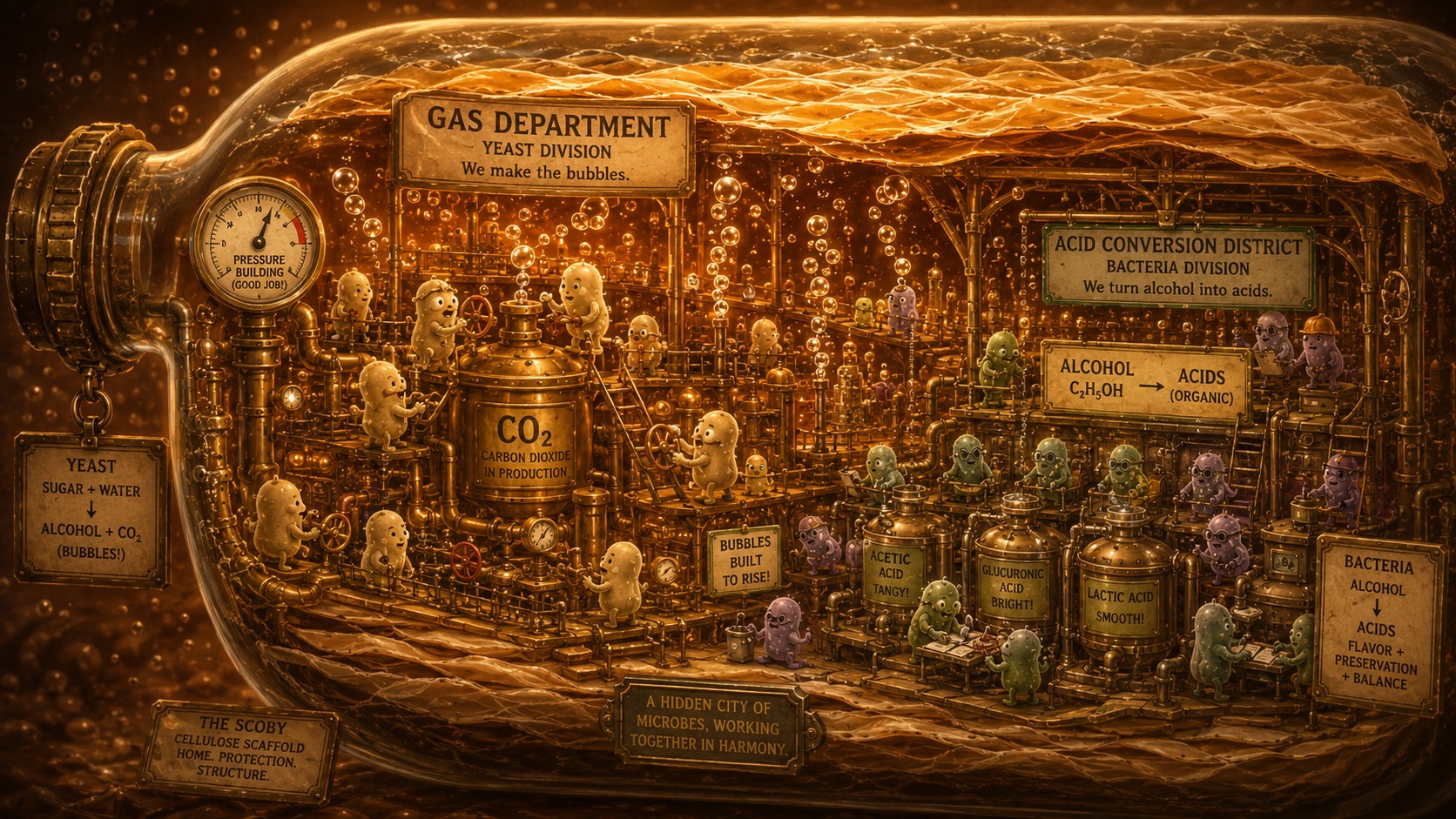
The bacteria are still doing important work in kombucha, but they are not the main bubble-makers. If you want fizz, thank the yeast. They are the gas department.
Burping Is the Kindest Way to Flatten Your Kombucha
There is a persistent second-fermentation habit among home brewers: opening bottles every day to “burp” them.
I understand the instinct. Nobody wants a glass grenade on the counter. But every time you crack the lid, you release pressure the yeast have been working to build. Do that often enough, and you may successfully prevent an eruption right along with most of the carbonation.
If your bottles are getting opened repeatedly during F2, flat kombucha should not come as a great surprise. You are asking the yeast to fill a bucket while you keep drilling holes in the bottom.
That does not mean pressure management is foolish. It means good bottle choice, reasonable sugar additions, and attention to temperature are generally better solutions than daily pressure sabotage.
What the Yeast Need From You
If you want reliable carbonation, the yeast need a few simple things.
1. Some Sugar to Work On
No sugar, no meaningful gas production. That sugar may come from residual sweetness left in the kombucha after F1, or from whatever you add at bottling time. Fruit juice works. Fruit puree works. Syrups work. Even a little plain sugar can work.
Artificial sweeteners and zero-sugar flavorings do not usually provide much for the yeast to ferment. If you flavor with something sugar-free, do not expect the bubbles to materialize out of goodwill.
2. A Sealed Bottle
Bottle seal aside, and yes, bottle seal matters a great deal, carbonation still depends on everything else being reasonably in order. But without a proper seal, the whole project starts with a handicap.
Good swing-top bottles, properly capped beer bottles, or sturdy soda-style bottles generally outperform decorative glass that was never meant to hold pressure.
3. Warmth
Cold kombucha is sleepy kombucha. Warmer room temperatures usually encourage more yeast activity, which means more CO2 production. That does not mean hot is always better, only that a chilly room often leads to sluggish bottle fermentation.
4. Time
Sometimes the answer to “Why isn’t my kombucha fizzy?” is simply “Because it is not ready yet.” A bottle that has had one day at 68°F is not the same creature as a bottle that has had three or four days at 76°F.
Juice, Puree, and the Bubble Launchpads
Now we get to one of the more interesting practical observations in home brewing: puree often seems to create more dramatic carbonation than juice.
And yes, I think your explanation is partly right.
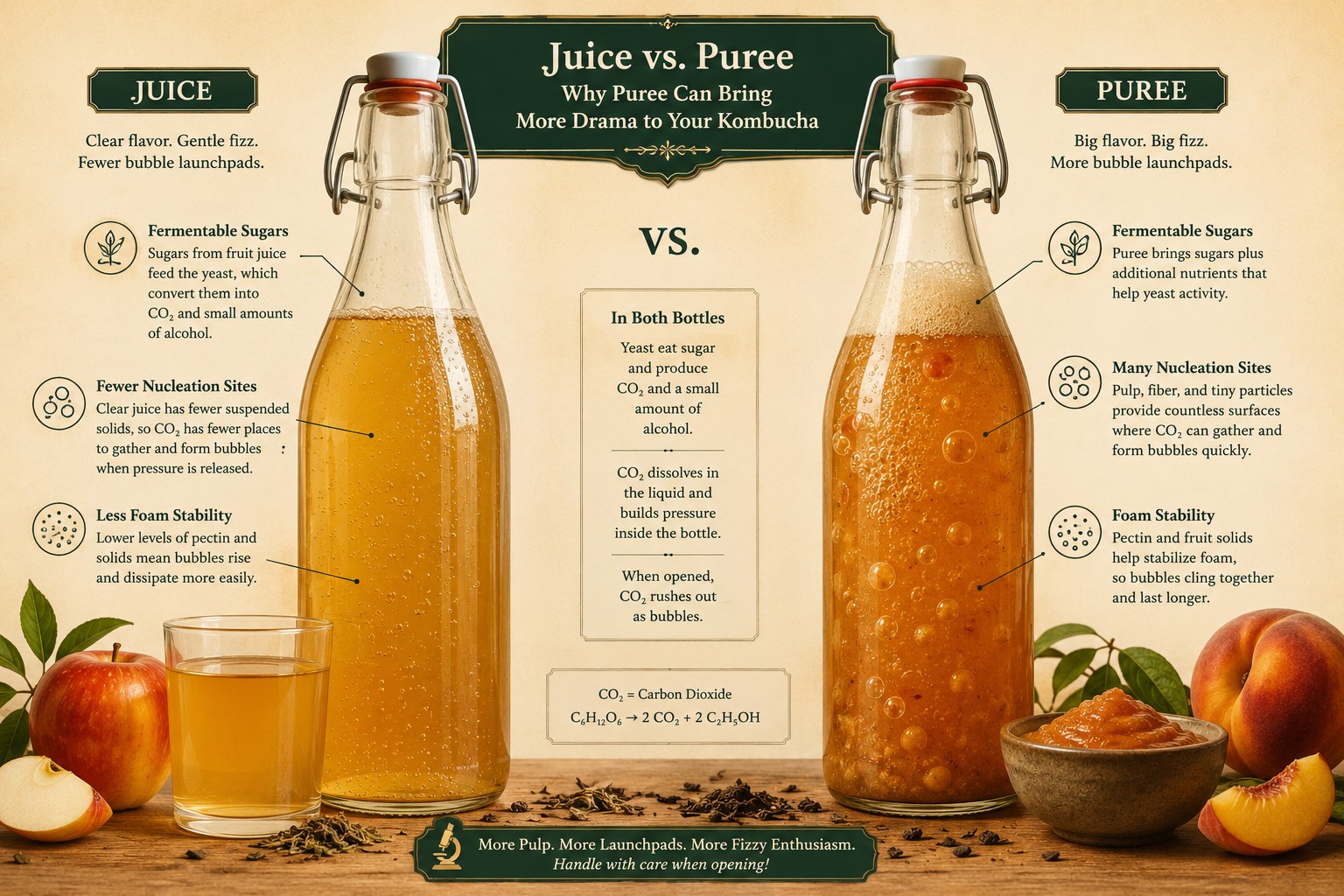
Fruit puree does not merely add flavor. It also adds pulp, fiber, pectin, cell fragments, and other suspended solids. Those tiny particles can act as nucleation sites, which is a scientific way of saying they give dissolved carbon dioxide places to gather and form bubbles quickly when the pressure is released.
In other words, puree can provide bubble launchpads.
That means puree may increase visible fizz in two different ways. First, it can contribute fermentable sugar and nutrients that help the yeast make more CO2. Second, it can make the carbonation already present announce itself with considerably more enthusiasm.
That is why a puree batch may seem far more explosive than a clearer juice batch, even when both contain substantial carbonation. Pectin and fruit solids can also help stabilize foam, so once the bubbles get going, they may keep climbing.
Impressive? Yes. Convenient? Not especially.
Why One Bottle Is Flat and Another Is a Weapon
Home brewers sometimes assume every bottle in a batch should behave identically. Kombucha does not always share that assumption.
One bottle may be flat while another is halfway to criminal charges. A few common reasons explain the difference.
- Uneven sugar distribution: If fruit, syrup, or puree was not mixed well, some bottles may get more fermentable material than others.
- Uneven solids distribution: One bottle may receive more pulp and suspended particles, which can dramatically affect nucleation and foam release.
- Slight differences in seal: Two bottles that look identical may not hold pressure equally well.
- Different headspace: Overfilled bottles and bottles with inconsistent fill levels can behave differently.
- Temperature variation: A bottle near a warmer part of the house may ferment faster.
So yes, bottle seal matters. But it is not the only variable in town.
How to Troubleshoot a Flat Bottle
If your kombucha is not getting fizzy, work through the boring possibilities before assuming your culture has lost the will to live.
Check the Seal
If the bottle cannot hold pressure, the yeast cannot win.
Check the Sugar Source
Did you add enough fermentable sugar? Did you use real juice, fruit, or syrup, or something mostly non-nutritive?
Check the Temperature
Cool rooms slow things down. That is not a defect. That is just biology.
Check the Timing
Some bottles simply need another day or two.
Check the Yeast Strength
If your kombucha was fermented extremely dry in F1, filtered heavily, or bottled from a batch with relatively little yeast carried over, carbonation may be slower.
Check Your Burping Habit
If you keep opening the bottle, the mystery may already be solved.
How to Keep Volcanic Kombucha From Repainting the Kitchen
If your problem is not flatness but overachievement, a few practices help.
- Use a little restraint with very sugary fruit purees.
- Mix thoroughly before bottling so one bottle does not get all the excitement.
- Do not overfill the bottle.
- Ferment at a sensible room temperature rather than a tropical one.
- Refrigerate thoroughly before opening.
- Open slowly over a sink, especially when using puree.
Chilling matters because colder liquid holds dissolved carbon dioxide better. A well-chilled bottle is often much less theatrical than a warm one.

Flat Does Not Mean Failed
Here is the reassuring part: flat kombucha is not necessarily bad kombucha.
If the flavor is pleasant, the acidity is where you want it, and the brew is otherwise sound, lack of fizz does not mean the batch is ruined. It may still be refreshing, balanced, and entirely worth drinking.
In beverage language, a non-carbonated drink is called still. So even when the bubbles are gone, it is still kombucha.
Or, more precisely, still kombucha.
That may be a slightly arcane joke, but the point stands: carbonation is a feature, not the sole measure of success.
The Brew Lab Takeaway
If your kombucha is flat, the explanation is usually not mystical.
Yeast need sugar, warmth, time, and a sealed bottle. Puree may create more dramatic carbonation not only because it can feed the yeast, but because it provides nucleation sites and foam-friendly solids that make the bubbles much more obvious on release. Frequent burping tends to flatten the whole enterprise. Weak seals do the same thing more quietly.
And if a bottle erupts like a tiny amber volcano, that is usually not magic either. That is carbon dioxide, fruit solids, pressure, and timing working together with a little too much enthusiasm.
References & Further Reading
- Jayabalan, R., Malbaša, R. V., Lončar, E. S., Vitas, J. S., & Sathishkumar, M. (2014). A Review on Kombucha Tea—Microbiology, Composition, Fermentation, Beneficial Effects, Toxicity, and Tea Fungus. Comprehensive Reviews in Food Science and Food Safety.
- Villarreal-Soto, S. A., Beaufort, S., Bouajila, J., Souchard, J.-P., & Taillandier, P. (2018). Understanding Kombucha Tea Fermentation: A Review. Journal of Food Science.
- Marsh, A. J., O’Sullivan, O., Hill, C., Ross, R. P., & Cotter, P. D. (2014). Sequence-based analysis of the bacterial and fungal compositions of multiple kombucha samples. Food Microbiology.
- Teoh, A. L., Heard, G., & Cox, J. (2004). Yeast ecology of kombucha fermentation. International Journal of Food Microbiology.
- Liger-Belair, G. (2005). The physics and chemistry behind the bubbling properties of champagne and sparkling wines. Journal of Agricultural and Food Chemistry.
- Centers for Disease Control and Prevention (CDC). (1995). Unexplained Severe Illness Possibly Associated with Consumption of Kombucha Tea—Iowa, 1995. MMWR.
Feed the yeast.
Seal the bottle.
Respect the puree.